MALCOLM SCHOFIELD: ‘The sun of Heraclitus’ • The Classical Review 50, 142/3 (Nº 1; 2000).
G.L.J. SCHÖNBECK: Sunbowl or Symbol. Models for the interpretation of Heraclitus' Sun Notion.
Pp. XLVI + 439, ills. Amsterdam: Elixir Press, 1998. Cased,
Hfl. 275. ISBN: 90-71409-03-1.
| This big, strange, and beautiful book is in origin a doctoral thesis, which after many years' labours in the composition was approved by the University of Amsterdam in the summer of 1998. | It is a kind of monument not only to a certain conception of scholarship, but also to the book as the physical object we used to know. |
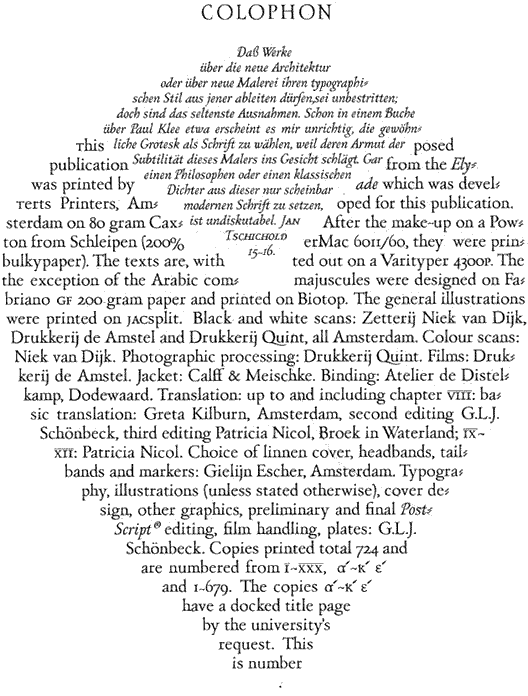
| Sunbowl or Symbol, though in the end the outcome of electronic processes, looks and feels like the product of one of the fine art presses which flourished in Britain during the inter-war period. It is printed in a limited edition (each copy with its own. handwritten number on 80 gr Caxton, with huge margins, book markers, hand-pasted ornamented initials, and illustrations, and such a combination of elegance and intricate complexity in the typography that the author was awarded the Max Reneman Prize for this aspect of the book. | As well as a general introduction, there is a separate prefatory section on ‘notations and typography’. S. uses a great variety of typographical conventions, including various symbols in the margins to indicate items in the text corresponding to an inventory of key topics (almost all wholly neglected in previous scholarship, in his opinion) presented as one of six appendices. All this is in service of his conviction that explicitness and ways of exhibiting explicitness are prime desiderata in Heraclitus scholarship, once again barely appreciated by previous workers in the field. Needless to say, there are excellent tables of content, and the book is superbly indexed. |
| S’s project is indicated in his subtitle: this is not a study of Heraclitus in general, but of one particular theme in his philosophy. There are among the generally acknowledged fragments of Heraclitus a handful about the sun, e.g. (to list those which most occupy S.) ‘The sun is new every day’ (fr. 6 DK); it has the ‘breadth of a human's foot’ (fr. 3 DK); ‘The sun will not overstep its measures; otherwise the Erinyes, helpers of justice, will find it out’ (fr. 94 DK). In recent years we have become aware that in the Derveni papyrus the last two are recalled together, which has prompted further debate on their original form. | In the gappy text of col. IV, as restored by K. Tsantsanoglou (see Studies on the Derveni Papyrus, edd. A. Laks and G.W. Most [Oxford, 1997], Chapter VI), the Derveni writer says that Heraclitus says: ‘The sun according to its own nature is a human foot in width, not exceeding its boundaries. For if it goes outside its width, the Erinyes, helpers of justice, will find it out.’ But S. investigates not just the bearing of the Derveni evidence on the question. Not the least of his contributions to the study of Heraclitus is another appendix in which he gathers together a larger collection of testimonia on the entire body of sun fragments than we had ever had before. |
| S. evidently thinks that in order to come to terms with these sayings we need at least three attributes. Fist, we need classical scholarship, i.e., the panoply of knowledge of Greek literature, philosophy, philology, history, art, and archaeology, especially in the archaic period but ranging well beyond that. But reconstructing an archaic Heraclitus, even if feasible, would not be enough. Second, we approach the material seriously underequipped if we do so without a knowledge of science and the history of science, especially astronomy and psychology—for how big the sun appears, e.g. at the horizon vs. the meridian, is a question pre-eminently for psychology. | Third, and above all else, we need to be aware that nothing about these sayings of Heraclitus is self-evident. In fact, in every dimension each is multiply problematical. And for every question we can think to ask there are a host of prior methodological issues to be raised and explored. Few earlier writers, in S’s view, have begun to see the necessity for doing so. One exception to which he frequently recurs is Karl Popper, in ‘Back to the Presocratics’, and subsequently in his debate with G.S. Kirk. But he thinks Popper’s work succeeds only in alerting us to the need to take questions of methodology seriously. |
| S’s enquiry is really a meta-enquiry. It is divided into three parts, devoted to a ‘characterization’ of the material, its problems, and the possibility of solutions. The division makes it sound as though there might have been progress: as though by the end one might perhaps have got a bit closer than at the outset to understanding how one might go about making sense of Heraclitus’ remarks about the sun. In the event, this expectation is not fulfilled. The fundamental reason for its non-fulfilment is that S. is a sceptic. | He is driven not by a sense of how despite all the difficulties an understanding of what Heraclitus meant might be achieved, but by a deep and apparently irrefragable conviction that there are always more difficulties to be negotiated than one is yet in a position to see one’s way through, and that there is always more ground-clearing work to be done before building can begin. S’s book contains immense and varied learning, and his ingenuity and perspicacity in formulating problematics is boundless: anybody thinking about Heraclitus on the sun will want to consult him. But in the end the experience of reading Sunbowl or Symbol was for me dispiriting: sustained and inconclusive meta-enquiry leaves one weary as well as hungry. St. John’s College, Cambridge MALCOLM SCHOFIELD |